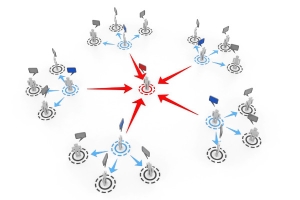
Organizational Network Analysis (ONA) is a visual representation of the relationships that employees rely on to succeed in their jobs. It depicts daily interactions and conversations that occur that enable work.
ONA provides leaders with an understanding of the “as is” network structure of their organization. They revel how work is actually getting done across teams and teaming levels.
ONA’s often reveal surprising truths that leaders may not realize about how their structures, processes, and teaming are either enabling or hindering work getting done. With this information, leaders can begin to intentionally shape the way their organizations interact, flow information, and work collectively.
Sounds amazing, right? Possibly even too good to be true? Well, before you make that assumption, keep in mind that moving to more flexible organizational structures, with an emphasis on supporting collaboration during knowledge-intensive work, has made it increasingly important for executives and managers to design and nurture networks within their organizations.
Human Networks
Organizational networks are composed of people, and during transformations people really matter. In your organization, who connects people across functions, geography and generations? Who acts as a “Hub” or “Bridge,” creating shortcuts across boundaries and functions, spreading ideas, information, and resources? Who represents the natural crossroads and bazaars where people meet and share ideas?
Networks focus energy. Transformation requires high amounts of energy from everyone, not just leaders and change agents. Locating the energizers (and the de-energizers) facilitates the translation of ideas into action, helps you obtain higher performance from those already participating, and increases the impact of learning on group behavior. Network energizers create a sweet spot within the organization where vision is clear, goals are compelling, people see ways to contribute, progress is tangible, and everyone believes they can succeed.
Intentionally Bridging Network Gaps
Organizational networks are highly patterned (or “clumped”) along certain dimensions. By understanding the dimensions that matter, you can analyze the ones that most influence your organization’s transformation, ensuring that they will work for you, not against you.
Most networks have gaps or structural holes that, when filled, connect people, ideas, and information. Connections within a network create “reciprocity” (getting information in exchange for giving it), and harnessing the power of reciprocity amplifies the help that people give each other by simply being part of the network.
“Role flexing” (taking on multiple roles) is common in networks. Analyzing networks lets us identify the roles people are informally adopting within the network. With this visualization, we can begin to “intentionalize” and design the network so that information and ideas flow from person to person. Asking the right questions of the right people and enlisting new people to shape the network structure helps support the work of transformation.
How do I participate in an Organizational Network?
The following roles exist within a human network:
- Connectors are individuals who link people together in the network. They are informal leaders who can be critical change agents. Their opinions influence others. They provide connections between people that the network taps into to get work done.

- Boundary Spanners are people who fill the gaps and holes in the network so that information moves across the organization. They make time to connect, consult and advise people from many different departments. Constantly curious, they are on the lookout for who’s doing what and how. They pass along this information to others they think need to know what is going on.

- Information Brokers are the glue at the local level of the organization. They create and maintain the network’s Small World characteristics. They also collect information from around the organization, consolidating it into a story of what’s happening and how it all relates.

- Peripheral Specialists occasionally participate in the network. Most often, they contribute to network activities because they’re vested in the network’s goals.
Visualizing human collaborative networks reveals the invisible inner workings of your organization, helping you intentionally build and shape networks for profound change, innovation and resiliency. These are essential tools for determining how work really occurs and for shaping the way work drives future growth.